

The Backdoor Roth IRA
By: Arash Navi, Senior Wealth Manager, CFP, CFA, CPA
A High Earner’s Path to Tax-Free Growth
The Roth IRA has become the retirement account of a generation. A decade ago, most families followed the traditional-IRA playbook their parents used — take the tax break now, pay the tax later. That script has flipped. According to the Investment Company Institute, older savers still lean traditional (46% of Baby Boomers own a traditional IRA versus 24% who own a Roth), but younger generations have reversed the pattern: Millennials now favor Roth’s (29% vs. 20% traditional), and Gen Z leans even harder that way (25% vs. 12%). Fidelity’s numbers are more striking still — Gen Z investors steer roughly 95% of their IRA contributions into Roth accounts, compared with 75% for Millennials and 66% for Gen X. Among twentysomethings, Roth participation nearly tripled between 2016 and 2022.
That enthusiasm tends to run into a wall right about the time it matters most. Once people are earning enough to contribute toward retirement comfortably and confidently, they often find themselves over the income threshold that lets them contribute to a Roth IRA.
In 2026, the ability to contribute directly to a Roth IRA phases out once your income passes $168,000 if you’re single (or $252,000 for a married couple). Cross that line and the front door is locked.
But here’s what most people don’t realize: there’s a back door into the Roth — completely legal, sanctioned by the IRS, and used by high earners every year. Best of all, it’s available to almost anyone with earned income — just an IRA and a few minutes of paperwork.
First, Why the Roth Is Worth Chasing
You contribute dollars you’ve already paid income tax on. From that point forward, every dollar of growth — dividends, interest, capital gains — is yours to keep. No tax while it grows, and no tax when you pull it out in retirement after age 59½.
Compare that to an ordinary taxable brokerage account: you owe tax on dividends every single year, and you owe tax on your gains when you sell. Over 30 years, that annual tax quietly skims a very large chunk of your returns. A Roth simply doesn’t have that drag — and if you’re a high earner in a high-tax state like California, facing the top brackets, sheltering your investments in a Roth means all of that growth compounds completely tax-free.
How the Backdoor Roth IRA Works
The strategy sounds fancy, but it’s really just a two-step move:
- Contribute to a traditional (nondeductible) IRA. There is no income limit to make a nondeductible contribution — anyone with earned income can do it. For 2026, the limit is $7,500 ($8,600 if you’re 50 or older). Because the contribution is nondeductible, it won’t reduce your taxable income — so there’s no upfront tax break, just the tax-free growth down the road.
- Convert that traditional IRA to a Roth IRA. There is also no income limit on Roth conversions. Since you already paid tax on the money going in, the conversion itself usually generates little or no tax.
That’s it. Money that couldn’t walk through the front door as a Roth contribution simply steps in through the back as a Roth conversion. Most custodians (Fidelity, Schwab, Vanguard) let you do both steps online in a matter of days.
“One important watch-out — the “pro-rata rule.” This is where most backdoor Roths go sideways. If you already have pre-tax money sitting in any traditional IRA, SEP, or SIMPLE IRA, the IRS won’t let you cleanly convert only your after-tax dollars. Instead, it blends all of your IRA money together and taxes the conversion proportionally — which can turn a “tax-free” move into an unexpected tax bill.”
The good news: this rule looks only at IRAs, not at workplace plans. So if you have a large pre-tax IRA balance, one common fix is to roll it into your current employer’s 401(k) (if the plan accepts it) before doing the backdoor Roth, leaving your IRA “empty” of pre-tax money. It’s worth a conversation before you pull the trigger.
A Real-Life Example: Meet Elena
Elena is a 30-year-old physician. She earns about $300,000 a year — comfortably over the Roth income limit for a single filer. She can’t contribute directly, so she’s deciding what to do with an extra $7,000 a year she wants to invest for the long haul.
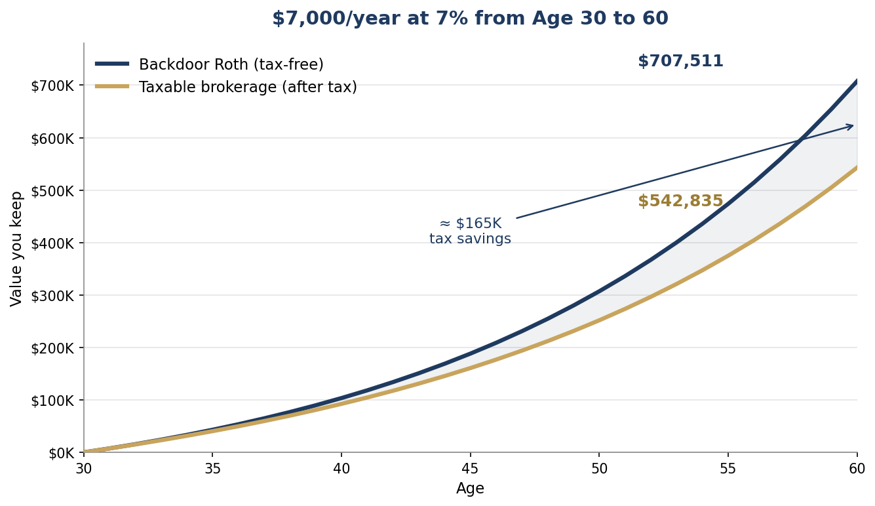
She has two choices: a taxable brokerage account, or the backdoor Roth IRA. To keep the math simple, let’s follow that $7,000-per-year account, invested at a 7% annual return from age 30 to age 60 — 30 years of steady saving. Both receive the same $210,000 in total contributions. The only difference is who gets to keep the growth.

In the Roth, the account grows to about $707,500 — and every penny is hers, tax-free, forever. In the taxable brokerage account, the money grows to that same $707,500 on paper, but selling triggers capital-gains tax on the ~$497,500 of growth. As a high earner in California, her long-term gains stack the top federal rate (20%), the 3.8% net investment income tax, and California income tax (~9.3% in her bracket) — a combined rate near 33%. That’s roughly $164,700 in tax, leaving about $542,800.
| At age 60 ($7,000/yr at 7%) | Taxable Brokerage | Backdoor Roth IRA |
| Total contributed | $210,000 | $210,000 |
| Account value (pre-tax) | ~$707,500 | ~$707,500 |
| Tax owed at the finish line | ~$164,700 | $0 |
| What she actually keeps | ~$542,800 | ~$707,500 |
That’s roughly $165,000 more in her pocket — from the same contributions, the same investments, and the same rate of return. The only variable that changed was the tax wrapper.
And here’s the kicker: the brokerage number is the best-case scenario, because it assumes no tax until the very end. In real life, a taxable account also throws off dividends taxed every year, quietly slowing the compounding. Factor that in and the Roth’s advantage stretches closer to $190,000. And we followed a modest $7,000 stream — Elena could contribute the full 2026 limit of $7,500, and every extra dollar compounds tax-free right alongside the rest.
A Few Things to Get Right
- Mind the pro-rata rule if you hold other pre-tax IRA money — clear it out first if you can.
- Convert promptly so you’re not taxed on growth between contribution and conversion.
- Keep the two steps clean — contribute to the traditional IRA, then convert; don’t invest the money in between.
- File Form 8606 to document nondeductible contributions — the paperwork that keeps the IRS from taxing you twice.
The Bottom Line
Younger savers have embraced the Roth for good reason — decades of tax-free growth are hard to beat. The frustrating part is that just as your career takes off, the income limits can shut the front door. The backdoor Roth is the answer: it lets high earners keep capturing that tax-free growth instead of watching it get quietly eroded by taxes in a brokerage account. For Elena, that’s an extra $165,000 (and likely more) for the price of a little paperwork.
Because it lives in an ordinary IRA rather than an employer plan, it’s a strategy that’s within reach for nearly any high earner with earned income. The mechanics are simple, but the details — especially the pro-rata rule and the timing — are where people trip up. Done right, it turns a few minutes of paperwork into decades of tax-free compounding.
If you’re wondering whether the backdoor Roth makes sense for your situation — or how to sidestep the pro-rata trap — please Talk With Us!
Disclosure: Please remember that past performance is no guarantee of future results. Different types of investments involve varying degrees of risk, and there can be no assurance that the future performance of any specific investment, investment strategy, or product (including the investments and/or investment strategies recommended or undertaken by Benefit Financial Services Group [“BFSG”]), or any non-investment related content, made reference to directly or indirectly in this blog will be profitable, equal any corresponding indicated historical performance level(s), be suitable for your portfolio or individual situation, or prove successful. Due to various factors, including changing market conditions and/or applicable laws, the content may no longer be reflective of current opinions or positions. Moreover, no portion of this discussion or information serves as the receipt of, or a substitute for, personalized investment advice from BFSG. contained in this blog serves as the receipt of, or as a substitute for, personalized investment advice from BFSG. To the extent that a reader has any questions regarding the applicability of any specific issue discussed above to his/her individual situation, he/she is encouraged to consult with the professional advisor of his/her choosing. Neither BFSG’s investment adviser registration status, nor any amount of prior experience or success, should be construed that a certain level of results or satisfaction will be achieved if BFSG is engaged, or continues to be engaged, to provide investment advisory services. BFSG is neither a law firm nor a certified public accounting firm and no portion of the blog content should be construed as legal or accounting advice. A copy of the BFSG’s current written disclosure Brochure and Form CRS discussing our advisory services and fees is available for review upon request or at www.bfsg.com. Please Note: BFSG does not make any representations or warranties as to the accuracy, timeliness, suitability, completeness, or relevance of any information prepared by any unaffiliated third party, whether linked to BFSG’s web site or blog or incorporated herein, and takes no responsibility for any such content. All such information is provided solely for convenience purposes only and all users thereof should be guided accordingly. Please Remember: If you are a BFSG client, please contact BFSG, in writing, if there are any changes in your personal/financial situation or investment objectives for the purpose of reviewing/evaluating/revising our previous recommendations and/or services, or if you would like to impose, add, or to modify any reasonable restrictions to our investment advisory services. Unless, and until, you notify us, in writing, to the contrary, we shall continue to provide services as we do currently. Please Also Remember to advise us if you have not been receiving account statements (at least quarterly) from the account custodian. Please see important disclosure information here.
Our Services

Investment Management
Tailor portfolios to your needs and goals.

Retirement Planning
Investing and saving wisely is vital to success in retirement.

Financial Planning
Navigating the complexities of your financial affairs can be simplified.

Tax Management
Help to increase the amount you “take home”.

Estate Planning
Protect your loved ones and make sure your legacy endures.

Executive Compensation Analysis
Simplify the many options and decision points of executive compensation plans.

Education Planning
Confidently plan for your children’s future.

Charitable Giving
Give in a tax-smart, simple way.
*Please Note: Limitations. The scope of services to be provided depends upon the terms of the engagement, and the specific requests and needs of the client. BFSG does not serve as an attorney, accountant, or insurance agent. BFSG does not prepare legal documents or tax returns, nor does it sell insurance products. Please Also Note: Different types of investments involve varying degrees of risk. Therefore, it should not be assumed that future performance of any specific investment or investment strategy (including the investments and/or investment strategies recommended and/or undertaken by BFSG) or any financial planning or consulting services, will be profitable, equal any historical performance level(s), or prove successful.
Sign Up For Our Newsletters
(They're great, we promise)
Explore
Connect With Us
California Office (Headquarters)
Wealth Management & Institutional Services
2040 Main Street, Suite 720, Irvine, CA 92614
Arizona Office
Wealth Management
1643 E. Bethany Home Road, Phoenix, AZ 85016