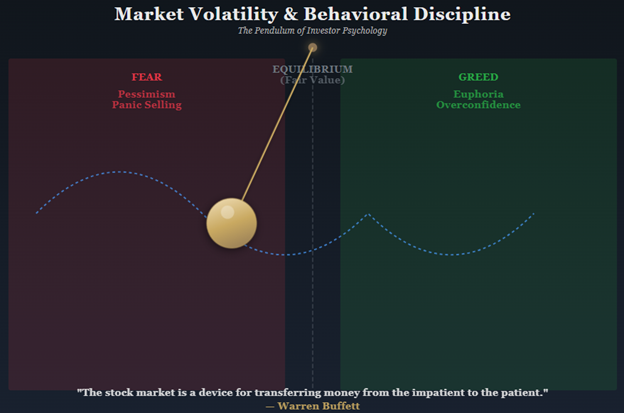
In recent weeks, the stock market has experienced increased volatility and pullbacks, particularly in the software and technology sectors, as investors digest information regarding how recent updates from Anthropic may impact the broader software landscape and whether AI spending by the Magnificent Seven will be fruitful. I thought this would be a good time to review key behavioral principles that investors—and those interested in investing in equities—should keep in mind.
We are all more connected than ever through our phones, notifications, and social media, and information is transferred far more rapidly than in the past. Combined with aggressive government policy changes such as tariffs, geopolitical tensions, and rapid advances in artificial intelligence, I believe we are likely to experience more frequent market volatility and sharper pullbacks driven by unsettling headlines and negative sentiment.
In these moments, the vast majority of investors may choose to reduce short-term anxiety by cutting their losses or locking in gains. However, a wise long-term investor should focus on valuation and keep behavioral principles in mind to maximize long-term returns by taking advantage of opportunities when good companies go on sale.
As Morgan Housel writes in The Psychology of Money:
“Doing well with money has little to do with how smart you are and a lot to do with how you behave.”
That insight becomes especially important during market downturns.
Why mindset, valuation, and discipline drive long-term investment success
1. Volatility Is the Price of Admission, Not a Market Failure
Market volatility is often viewed as a problem to avoid, but in reality, it is the cost investors pay for long-term returns. Equity markets fluctuate precisely because they offer higher expected returns than safer assets like cash.
Warren Buffett captured this idea succinctly:
“The stock market is a device for transferring money from the impatient to the patient.”
Behavioral finance research highlights loss aversion—our tendency to feel losses more intensely than gains—as a key reason investors struggle during downturns. Those who sell in response to fear often convert temporary market declines into permanent capital losses. Long-term investors, by contrast, accept volatility as a necessary part of the journey.
Check out this BFSG short video on loss aversion: https://youtu.be/xBrMdBwY1wU?si=-ugGzF_UcKNhoady
2. Focus on Valuation, Not Headlines
Market declines are rarely driven solely by fundamentals. More often, they are amplified by fear, uncertainty, and emotionally charged narratives. Headlines change daily, but valuation drives long-term returns.
Benjamin Graham, widely regarded as the father of value investing, emphasized that markets frequently swing between excessive optimism and excessive pessimism. During downturns, prices often fall faster than underlying fundamentals, creating more attractive valuations.
Howard Marks of Oaktree Capital reinforces the importance of this perspective:
“You can’t predict, but you can prepare.”
Preparation means focusing on valuation, margin of safety, and long-term cash flows—rather than reacting to short-term sentiment. When prices decline while fundamentals remain intact, future return potential often improves.
3. Downturns Are Where Long-Term Returns Are Born
While most investors intellectually understand the concept of “buying low,” few find it emotionally comfortable to invest when markets are falling. Yet history suggests that periods of pessimism have often laid the foundation for strong long-term returns.
Legendary contrarian investor John Templeton observed:
“Bull markets are born on pessimism, grow on skepticism, mature on optimism, and die on euphoria.”
Market downturns reset expectations. Lower prices today often imply higher expected returns in the future—even if short-term uncertainty remains elevated. Investors do not need to time the exact bottom to benefit; staying invested and maintaining discipline has historically been far more important.
4. Behavior Matters More Than Forecasting
During volatile markets, investors often search for certainty—forecasts, predictions, and definitive answers about what comes next. But even the most successful investors acknowledge that short-term market movements are unknowable.
Morgan Housel emphasizes that reasonable behavior often beats rational precision. A theoretically optimal strategy is ineffective if an investor cannot emotionally stick with it during periods of stress.
Common behavioral mistakes during volatility include panic selling, abandoning diversification, and chasing perceived “safe” assets at market lows. Avoiding these behaviors has historically mattered more than predicting market direction.
5. Long-Term Growth Requires Emotional Endurance
Market downturns test conviction. The ability to remain patient during uncomfortable periods is one of the most valuable—and rare—investing skills.
Charlie Munger summarized this reality simply:
“The big money is not in the buying and selling, but in the waiting.”
Compounding requires time and consistency. Investors who view downturns as opportunities to rebalance, invest gradually, or accumulate assets at more attractive valuations are often better positioned for long-term growth than those who retreat in response to fear.
Final Thought: Opportunity Rarely Feels Comfortable
Market volatility is unavoidable. But history shows that investors who focus on valuation, fundamentals, and disciplined behavior—rather than short-term noise—are more likely to achieve favorable long-term outcomes.
Periods of pessimism and negative sentiment often feel uncomfortable in the moment. Yet they have repeatedly proven to be environments where fortunes are quietly built.
By focusing on company fundamentals and valuation, a wise investor will take advantage when indiscriminate selling occurs, which will likely occur more often due to vast holdings in passive ETFs, risky leveraged investing, and individuals chasing higher highs rather than monitoring their holdings’ valuations.
Disclosure: Please remember that past performance is no guarantee of future results. Different types of investments involve varying degrees of risk, and there can be no assurance that the future performance of any specific investment, investment strategy, or product (including the investments and/or investment strategies recommended or undertaken by Benefit Financial Services Group [“BFSG”]), or any non-investment related content, made reference to directly or indirectly in this blog will be profitable, equal any corresponding indicated historical performance level(s), be suitable for your portfolio or individual situation, or prove successful. Due to various factors, including changing market conditions and/or applicable laws, the content may no longer be reflective of current opinions or positions. Moreover, no portion of this discussion or information serves as the receipt of, or a substitute for, personalized investment advice from BFSG. contained in this blog serves as the receipt of, or as a substitute for, personalized investment advice from BFSG. To the extent that a reader has any questions regarding the applicability of any specific issue discussed above to his/her individual situation, he/she is encouraged to consult with the professional advisor of his/her choosing. Neither BFSG’s investment adviser registration status, nor any amount of prior experience or success, should be construed that a certain level of results or satisfaction will be achieved if BFSG is engaged, or continues to be engaged, to provide investment advisory services. BFSG is neither a law firm nor a certified public accounting firm and no portion of the blog content should be construed as legal or accounting advice. A copy of the BFSG’s current written disclosure Brochure and Form CRS discussing our advisory services and fees is available for review upon request or at www.bfsg.com. Please Note: BFSG does not make any representations or warranties as to the accuracy, timeliness, suitability, completeness, or relevance of any information prepared by any unaffiliated third party, whether linked to BFSG’s web site or blog or incorporated herein, and takes no responsibility for any such content. All such information is provided solely for convenience purposes only and all users thereof should be guided accordingly. Please Remember: If you are a BFSG client, please contact BFSG, in writing, if there are any changes in your personal/financial situation or investment objectives for the purpose of reviewing/evaluating/revising our previous recommendations and/or services, or if you would like to impose, add, or to modify any reasonable restrictions to our investment advisory services. Unless, and until, you notify us, in writing, to the contrary, we shall continue to provide services as we do currently. Please Also Remember to advise us if you have not been receiving account statements (at least quarterly) from the account custodian. Please see important disclosure information here.